


Key Takeaways
- Lumber warps when moisture changes unevenly across a board, so one side shrinks or swells more than the other.
- The main types of warp are bow, crook, cup, and twist; USDA also classes kink as a separate type.
- Uneven support is a storage cause yards control: supports should be evenly spaced and lined up so boards can’t sag between them.
- Dry lumber picks up moisture in storage: about 2% a month for the first 45 days under a pile roof outdoors in humid weather, versus 0.3% a month in a closed shed (USDA).
- Mild cup can ease as moisture evens out, but warp that sets in during storage is often permanent, so prevention beats repair.
Not every warped board left the mill that way. Plenty of straight, dry stock bows or twists while it waits for a buyer. For a lumber yard or dealer, lumber warping costs twice: warped stock sells at a discount or not at all, and someone has to pull and sort it.
Warp can start while the wood dries, while it sits in storage, or after it’s installed. This guide covers the types and causes, then spends extra time on storage, the stage a yard controls, with USDA guidance on support, clearance, and covers, and how lumber yard storage systems put it to work.
What Is Lumber Warping, and What Does Each Type Look Like?
Lumber warping is any change in a board’s shape away from flat and straight. The USDA Forest Products Laboratory’s Air Drying of Lumber handbook traces it to wood shrinking by different amounts along its length, width, and thickness, and to irregular grain.
What Are the Types of Wood Warping?
USDA groups warp into five types. Kink, the one most guides leave out, is the one most tied to stacking.

Flatsawn boards cup toward the bark side as they dry (USDA FPL).
What Causes Lumber Warping?
Lumber warping causes stack on each other: moisture, the wood itself, and storage.
Why Does Moisture Make Wood Warp?
Wood doesn’t shrink until its moisture content falls below the fiber saturation point, about 28 to 30% for North American species (Purdue Extension). Below that point, it moves with every change in humidity, and not evenly. Tangential shrinkage, along the growth rings, is about twice radial shrinkage, which is why flatsawn boards cup.
The USDA Storage of Lumber handbook puts it plainly: uneven wetting or drying causes warp. That includes wood warping from water. Dry lumber soaked by rain or wet ground can warp, and solid piles hold that water longest.
Do Grain and Species Matter?
Yes. Cross grain (spiral or diagonal grain) is the main grain-related cause of warp. Juvenile wood near the pith and compression wood shrink more along their length than normal wood, pulling boards out of line.
Species matters too. USDA rates cedars, redwood, and spruce low in warping tendency, Douglas-fir and hemlocks intermediate, and cottonwood, sweetgum, and sycamore high.
How Does Storage Cause Warping?
The common storage causes:
- Ground contact: wet ground feeds moisture into the bottom of the pile.
- Rain on open piles: uneven wetting means uneven movement.
- Uneven support: boards sag between supports that are too far apart or out of line.
- Unsupported ends: per Purdue, boards hanging more than a foot or two past a pile without support warp severely during drying.
How Does Rack Support Affect Lumber Warping?
A stored board acts like a beam. If supports are too far apart or out of line, gravity bends it and moisture changes lock the bend in. Even, multi-point support is the warp control a yard owns outright.
USDA’s storage handbook calls for crossbeams under most sticker tiers, with bolsters lined up so the stack doesn’t sag. On cantilever racks, the arms do the crossbeams’ job. Four rules carry over:
- Space arms for the material. Our guide to cantilever arms sets a rule of thumb: arms no farther apart than half the length of the material. Thin plywood needs tighter spacing than heavy dimensional lumber.
- Limit overhang. Loads should overhang the arms by no more than half the distance between upright centerlines.
- Keep supports level and in line. Out-of-line stickers or bolsters can bend a board into a kink (USDA).
- Expect bow if you get it wrong. As our lumber storage rack guide explains, boards that sag between arms spaced too wide bow permanently.


Parr Lumber in Damascus, Oregon needed one facility to hold long lumber, boxed hardware, and trim and sheet goods. We matched the rack to the product: cantilever for long lumber, pallet rack for hardware, and custom 16 ft A-Frame frames for trim and sheet goods, because standard vertical racking didn’t fit their sizes. The 74-bay project passed final building inspection.

How Do You Stop Lumber From Warping in a Yard or Warehouse?
How to avoid wood warping in a yard comes down to four principles from the USDA Dry Kiln Operator’s Manual: well-spaced stickers, good pile foundations, room between piles, and good pile roofs. As a checklist:
- Keep lumber off the ground: at least 12 to 18 inches of clearance, more on unpaved yards.
- Sticker wet stock. Lumber at 20% moisture content or more held in storage should be stickered.
- Solid-pile dry stock only if it stays out of the rain.
- Line up supports with the sticker tiers, and keep them level.
- Match arm spacing to the material and keep overhang short.
- Cover outdoor stock. Covers must be rain-tight and project past the pile ends and sides.
- Store dry stock under the most protection you have. USDA measured moisture regain in 1-inch kiln-dried softwood: about 2% a month for the first 45 days under a pile roof outdoors in humid weather, about 1% a month in open sheds, and about 0.3% a month in closed sheds.
- Rotate stock first in, first out, because moisture regain adds up month by month.
What Changes When Lumber Is Stored Outdoors?
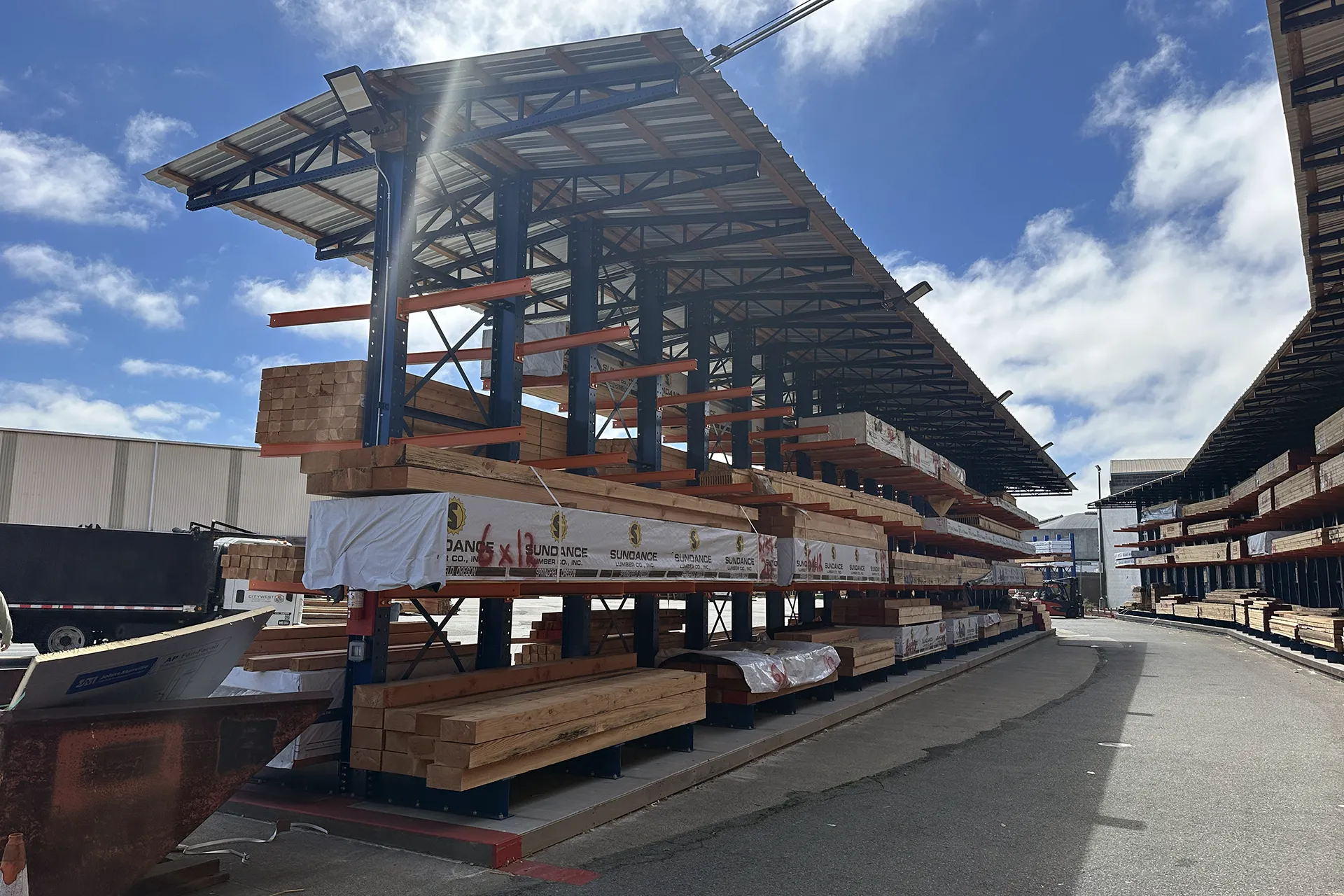
Outdoor racks need galvanized or powder-coated finishes, foundations planned for drainage, and usually a concrete pad rather than asphalt. Outdoor cantilever racks with roof supports add the cover USDA recommends without a separate building.
A Bay Area lumber yard took this route in two phases. Phase 1 was a 20 ft cantilever system with an 8 ft roof overhang that keeps stacked lumber dry without a standalone structure. Phase 2 added an 18 ft double-sided system with 4 arm levels per column and roof trusses.
Lumber Warping FAQs
Is there a way to straighten warped lumber?
Sometimes, partly. Cup caused by moisture can move back toward flat once the board’s moisture evens out again (USDA FPL). Planing can flatten a cupped board, but it removes thickness, and the board may cup the other way if its moisture rises later. Bow from sagging on wide-spaced supports is usually permanent.
Will warped wood go back to normal?
Not reliably. A flatsawn board’s cup changes as its moisture changes, so some cup can ease once moisture evens out. But repeated wetting can buckle surface fibers for good, and bow from long-term sagging stays. Treat warp that sets in during storage as permanent.
Does wood ever stop warping?
No, not fully. Wood keeps picking up or giving off moisture to match the air around it. It only stops moving when temperature and humidity hold steady long enough for it to reach its equilibrium moisture content (Purdue Extension). In a real yard or building, humidity keeps changing, so the wood keeps moving.
Can water make wood warp?
Yes. Rain, melting snow, and contact with wet ground can warp even well-dried lumber (USDA). Bulk-piled stock is at more risk than stickered stock because water can’t easily evaporate from a solid pile. Ground clearance and rain-tight covers are the first line of defense.
Keep Your Stock Straight
Lumber warping starts with moisture, but storage decides how much of it you end up discounting.
- Uneven moisture causes warp; grain and species set how much.
- Even, level, multi-point support and rain-tight cover are the warp controls a yard owns.
- Warp that sets in during storage is often permanent, so prevention costs less than sorting.
Tell us what you stock and how long it sits, and we’ll spec a lumber storage rack with arm spacing and overhang matched to your material. Call 503-640-5666, or build your lumber storage rack online.
Was this helpful?


