

-
Warehouse Racking
Warehouse Racking See all
-
Conveyors
Conveyors See all
-
Shelving
Shelving See all
-
Mezzanines
Mezzanines See all
-
Accessories
Accessories See all
-
Safety Products
Safety Products See all


Rack Accessories
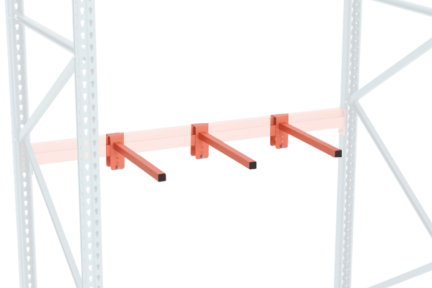
Speedrack West stocks the pallet racking accessories warehouses need to stay safe, organized, and code-compliant: wire mesh partition cages, load capacity labels, pallet rack row spacers, single divider arms, hose rack hanging kits, column protectors, wire decking, safety straps, and pallet rack anchors. Browse the accessories below, or call 503-640-5666 if you’re not sure which parts fit your setup.


Common Pallet Rack Accessories
Every rack system draws from the same core categories of accessories, even if the exact parts change with what you store. Here’s what we carry, organized by the job each one does on your rack.
Advantages of Pallet & Warehouse Rack Accessories
Adding the right accessories to a pallet racking system pays off in ways you’ll notice fast:
- Fewer damaged racks. Column protectors and row spacers absorb the daily wear a warehouse floor puts on a frame, so you’re not replacing bent uprights every year.
- Safer aisles. Wire decking, safety straps, and load capacity labels cut down on falling product and overloaded beams, the two most common causes of rack-related injuries.
- Better inventory control. Divider arms and partition cages keep mixed SKUs, oversized items, and high-value stock separated and easy to find.
- Longer rack life. Accessories built for impact resistance protect a rack from forklift hits and overloading, so it lasts years longer than one left bare, which means fewer repairs and replacements down the road.
- A system built around what you store. Accessories let you adapt one rack footprint to lumber, small parts, drums, or mixed pallets instead of buying a different system for each.
Where These Accessories Matter Most
- General warehousing and distribution. Row spacers, wire decking, and load capacity labels are the baseline for any facility moving palletized freight through multiple aisles.
- Cold storage. Wire decking and column protectors rated for the temperature swing matter more here, since cold-formed steel behaves differently in a freezer than on a dry floor.
- Manufacturing floors. Column protectors and safety straps see the most use near forklift traffic and staging areas, where a single distracted pass can do real damage.
- Multi-SKU and mixed-inventory operations. Divider arms and partition cages are what let one rack row hold pallets, small parts, and tools side by side instead of forcing a separate system for each. Speedrack West set up exactly this kind of combined layout, pallet rack, boltless shelving, and cantilever racks together, for a plumbing and waterworks distributor in North Plains, OR, after their inventory outgrew a single rack type.
What Protects Your Rack Structure?
Forklift impact does more damage to a rack system than overloading does, and it happens at the same few spots every time: row ends, column corners, and aisle intersections.
- Column Protectors work as aisle guards at row ends and absorb the impact when a forklift clips an upright, the single most common cause of rack damage on a busy floor.
- Guard Rails section off the base of a rack row from forklift traffic entirely, so an operator has to hit steel bolted to the floor before ever reaching the upright.
- Heavy Duty Bollard Posts protect a single column or corner the way a guard rail protects a full row, for tight spots where a full rail doesn’t fit the aisle.
- Pallet Rack Guard covers the parts of a frame column protectors don’t reach, for warehouses that want impact protection across the whole footprint instead of just the row ends.
A bollard post costs a fraction of an upright replacement. An upright replacement costs a fraction of a workers’ compensation claim.
What Keeps Loads Supported and Decked?
A beam only holds what’s sitting directly on it. Everything else on the level depends on the decking and supports underneath.
- Pallet Rack Wire Decking acts as a pallet support across each beam level, holding cartons and hand-stacked product while preventing pallets from falling through to the level below.
- Pallet Rack Crossbar Supports sit between the beams and the decking to spread a load’s weight more evenly, which matters most for uneven pallets, slip sheets, or product that doesn’t sit flush on a standard pallet.
What Keeps a Rack Safe and Code-Compliant?
Most rack-related injuries come down to two things: something falling off a level, or a beam carrying more than it’s rated for.
- Pallet Rack Row Spacers connect back-to-back rows so they can’t shift or lean into the aisle, and keep the flue space between rows clear for your sprinkler system.
- Pallet Rack Safety Straps are heavy duty connectors that reinforce the beam-to-column connection and cut the risk of a beam knocking loose under load.
- Pallet Rack Safety Nets catch product before it clears the rack and lands in an aisle, and a sliding version is available where the net needs to move for restocking.
- Pallet Rack Flue Guard blocks product from being pushed into the flue space between back-to-back racks, the same clearance your row spacers are protecting from the side.
What Stops a Beam from Working Loose?
A beam that isn’t locked to its column can walk loose from ordinary forklift vibration over time, with no warning before it happens.
- Pallet Rack Drop Pins lock a beam to its column connector so it can’t be lifted off the frame from below.
- Pallet Rack Safety Clips do the same job from the side, snapping into the connector for a faster install where a drop pin isn’t the right fit. Read our breakdown of beam locking pins versus clips if you’re not sure which one your rack takes.
How Do You Know Which Accessories Your Warehouse Actually Needs?
The honest answer is that most warehouses don’t find out until someone inspects the rack column by column. Speedrack West now works with more than 12 Evraz North America warehouses after starting with a single safety inspection at their Portland facility.
Two inspectors spent four days checking every rack in the building, columns, anchor plates, struts, beams, and frames, from five directions, without shutting the warehouse down.
Damaged racks got tagged red and replaced, some upgraded to a higher capacity instead of just repaired, and inventory got re-planned to match what the rack could actually carry.
That’s the difference between guessing at accessories from a parts list and finding out what your rack actually needs. If you’re not sure whether your floor needs more structural protection, better decking, or code-compliance hardware, that’s exactly what an inspection answers. Call us at 503-640-5666 and we’ll walk your floor with you.
PalletRack Accessories Frequently Asked Questions
What are common pallet rack accessories?
The most common pallet rack accessories are row spacers, divider arms, load capacity labels, wire decking, column protectors, and safety straps. Row spacers stabilize back-to-back rows, divider arms organize mixed SKUs on a beam level, and load capacity labels post the weight limit for each level. Column protectors and safety straps guard against the two things that damage racks fastest: forklift impact and overloading.
What accessories are available for stack racks?
Stacking racks use a different accessory set than pallet rack, since the frames stack directly on loaded pallets instead of bolting to a fixed upright. Key accessories include locking pins or interlocking connectors to prevent shifting, load capacity labels rated to stack height and weight per tier, and corner or base protectors for the bottom frame. Custom configurations are available for tires, pipe, or drums.
Should pallet racking be bolted to the floor?
Yes. The Rack Manufacturers Institute’s ANSI MH16.1 standard requires every pallet rack column to be anchored to the floor with bolts, which keeps a loaded frame from tipping during a forklift collision or seismic event. Bolt size and count are specified by a manufacturer or engineer based on your installation. We carry pallet rack anchors sized for standard and seismic-rated systems.
Do rack accessories differ by frame type, like teardrop versus structural?
Yes. Teardrop-style pallet rack uses stamped connector holes with clip-in accessories like drop pins and safety clips, while structural rack bolts every connection, including crossbars and safety straps, since there’s no stamped pattern to clip into. An accessory built for one frame type usually won’t fit the other without an adapter. Our guide to pallet rack components walks through how to identify your frame, or call us and we’ll match accessories to your system.
Should I prioritize safety accessories or organization accessories first?
Safety first, every time. Column protectors, safety straps, safety nets, and drop pins or clips address the failures that cause injuries and OSHA citations under the agency’s General Duty Clause, while divider arms and partition cages address efficiency. A warehouse with perfectly organized but unprotected racking is one forklift mistake away from a serious incident. Get the safety accessories in place first, then let organization accessories speed up the day-to-day work.