


Single-sided versus double-sided. Structural versus roll-formed. Fixed arms versus adjustable. Each choice affects load distribution, anchoring requirements, permit triggers, and how long your system stays safe under forklift traffic.
This guide covers every major cantilever rack configuration, what each type handles well, and where misapplication creates real problems. If you’re storing long, heavy, or irregular materials, this is where to start before you buy anything.
Single-Sided Cantilever Racks: Wall-Adjacent, Not Wall-Dependent
Single-sided cantilever racks have arms extending from one face of the upright only. They’re designed to sit against a wall or building column, making them a natural fit for perimeter storage layouts where floor space is at a premium.

The load distribution is simpler than in a double-sided system; arms extend in one direction, the base anchors against the load’s pull, and the upright takes the vertical compression. Double-sided systems are more structurally efficient because opposing loads counter-balance each other, reducing stress on the base. Single-sided systems don’t carry that advantage, but a single-sided upright can be engineered to the same arm capacity as a double-sided one through heavier steel gauge or a larger base. The difference is efficiency, not ceiling.
Common mistake: Facilities push single-sided racks against a wall and skip base anchoring, assuming the wall provides support. The wall does nothing structurally. Every cantilever rack, single or double-sided, needs floor anchoring based on the arm load rating and seismic zone.
Single-sided systems are the right call when:
- Your layout requires tight perimeter use with narrow aisle clearance
- You’re storing lighter long goods: PVC pipe, aluminum extrusions, trim boards, where arm capacity under 3,000 lbs per arm is acceptable
- The facility has structural columns you can mount adjacent to for additional reference points (not load transfer)

Double-Sided Cantilever Racks Require More Planning, Not Just More Space
Double-sided systems extend arms from both faces of the upright. This design creates balanced load distribution across the column and dramatically increases storage density per linear foot of floor space. It’s the standard configuration for high-volume operations storing lumber, steel bars, pipe bundles, or sheet goods at scale.

The engineering advantage is real: balanced arm loads on both sides reduce the net moment force on the upright and base. A double-sided rack loaded evenly is structurally more efficient than two single-sided racks of equal capacity. That efficiency makes double-sided systems the default for most lumber yards and steel distributors.
The planning requirement people miss: double-sided cantilever racks sit in the middle of an aisle, not against a wall. You need enough aisle width for loaded forklifts on both sides simultaneously. Minimum 12 feet for standard counterbalance forklifts, often more for the material lengths you’re moving.
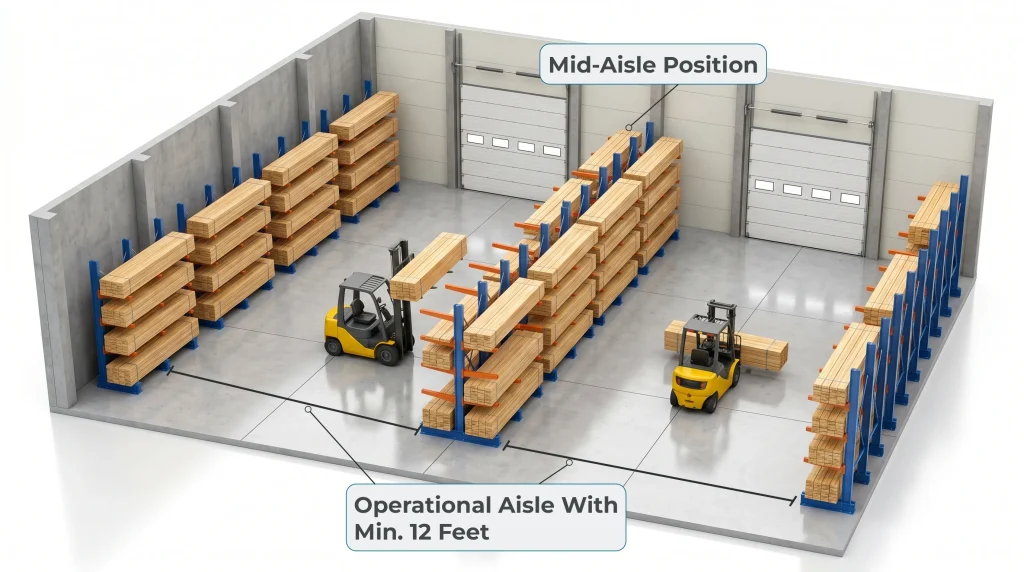
Double-sided systems are the right call when:
- You’re storing high-volume, uniform-length materials (lumber, steel bar, conduit, pipe)
- Forklift access on both sides is feasible in your facility layout
- You want maximum storage density per column; double-sided racks at full capacity outperform two single-sided systems by 20–40% in usable positions per square foot
Structural vs Roll-Formed: The Difference That Determines Forklift Compatibility
This is the first decision that shapes everything else.
Structural cantilever rack uses hot-rolled steel arms, heavier gauge, bolted connections, significantly higher load capacity, and impact resistance. It handles frequent forklift loading, heavy stock, and outdoor exposure without degrading. Arm capacities range from 1,500 lbs on lighter structural configurations up to 20,000 lbs per arm on super heavy-duty systems. It costs more upfront and takes longer to install, but it’s built for the environments most of our customers actually operate in.
Roll-formed rack uses cold-formed lighter-gauge steel with boltless pin connectors. It assembles faster and costs less upfront. You’ll encounter it from other suppliers in the market. The tradeoff is impact tolerance; roll-formed steel dents and deforms more readily under forklift contact, has lower arm capacity ceilings, and requires more frequent inspection in active facilities. It’s become increasingly uncommon in professional warehouse applications as structural pricing has become more competitive.


Speedrack West stocks and recommends the structural cantilever as the standard. It’s more versatile, more durable, and a better long-term investment than the alternative.
The components are not interchangeable. Once you choose structural or roll-formed, the entire system must use that type throughout.
| Rack Configuration | Arm Load Capacity | Max Levels | Total Load Capacity | What It Stores |
|---|---|---|---|---|
| 48″ x 4″ Arms | 2,600 lbs | 4 | 10,400 lbs | Lumber, pipes, building materials |
| 48″ x 5″ Arms | 3,000 lbs | 3 | 9,000 lbs | Lumber, pipes, building materials |
| 60″ x 4″ Arms | 2,000 lbs | 5 | 10,000 lbs | Lumber, pipes, building materials |
Need to store something outside these configurations? Contact us — we’ll guide you to the right solution.
Adjustable Arms: Why Fixed Configurations Cause Problems When Inventory Changes
Most structural cantilever systems ship with adjustable arms. Arms that pin at different heights along the upright column, allowing vertical spacing to change as inventory changes. This matters more than it seems at purchase time.

A lumber yard handling 8-foot boards and 16-foot boards simultaneously needs arm heights set for the actual bundle diameters. A plumbing distributor adding larger-diameter pipe to their SKU mix needs to reposition arms without buying new columns. Fixed-arm systems eliminate that flexibility.
The capacity error happens here: arm length and arm capacity are not the same spec. A longer arm doesn’t mean a higher load rating. It often means the opposite. Extended arms create more moment force on the column connection. Always match arm selection to the actual material weight at the actual overhang distance, not just the load you want to store.
Adjustable arm systems also allow you to run a single upright column height through multiple load zones: heavy stock on lower arms, lighter goods up top without buying separate systems. That kind of vertical zoning is standard practice in steel service centers and lumber operations running mixed SKU depths.
When Standard Configurations Don’t Fit the Material
Outdoor Cantilever Racks
Outdoor installations introduce three variables that change the engineering: surface substrate (asphalt vs concrete vs compacted gravel), weather exposure (galvanized or powder-coated finish requirements), and wind load. Structural cantilever is the default for outdoor use, roll-formed steel corrodes faster and dents more readily under outdoor material handling conditions.

Critical point many facilities miss: you cannot anchor cantilever racks into asphalt. Asphalt compresses under load and provides no reliable anchor resistance. Outdoor cantilever rack installations require a proper concrete foundation; either an existing concrete pad or a poured footing designed for the specific rack load. This is not optional; it’s the difference between a stable system and one that tips under a full load.

Pipe, Tubing, and Bundle Storage
Round stock (pipe, conduit, tubing, rebar bundles) rolls. Standard flat arms let bundles shift laterally under load or forklift vibration. The solution is arm stop pins or angled arms that cradle round material. This is a simple accessory decision that prevents material falls, which are both a safety hazard and a product damage event.


For the Consolidated Supply installation in Tigard, the custom stackable pipe bunks Speedrack West fabricated solved this exactly; forklift fork guides at the base, stackable to three levels, rated to 4,000 lbs per stack. Standard off-the-shelf pipe racks don’t include forklift sockets, which meant every load and unload was slower and less controlled. The custom design cut material handling time by 45%.

Sheet Goods and Panel Storage
Plywood, MDF, sheet metal, glass panels, and composite panels are heavy, large, and prone to warping if stored flat for extended periods. Vertical A-frame racks address this, panels stand on edge, weight distributes along the length, and warping risk drops significantly. A-frame systems function similarly to cantilever in that they handle oversized inventory that pallet racking can’t, but the orientation and load logic are different.

If your material is long and flexible (thin aluminum sheet, vinyl plank flooring), flat arm storage with close arm spacing prevents sag. If it’s rigid and thick, arms can be spaced further apart.
The rule is simple: arm spacing should never allow material to deflect more than 1 inch at mid-span. Beyond that, you’re looking at a permanent set in the material.


Cantilever Racks Are Frequently Flagged During Inspections
Cantilever racking triggers permit requirements in most U.S. jurisdictions, but the threshold depends on your local authority and what type of permit applies. Building permits typically kick in above 5’9″. High pile storage fire permits apply when the top of the product exceeds 12′ for non-hazardous materials; lower for flammable goods. When in doubt, check with your local building department and fire marshal before installation.
Anchoring Failures
The most common. Cantilever racks generate significant base moment forces, particularly when loaded asymmetrically. Bases that aren’t anchored or anchored into a substrate that can’t provide the required pull-out resistance fail under load or seismic events. Concrete thickness matters. Minimum 3.5 inches for standard anchor bolts, and the concrete must be cured and in good condition. Cracked or thin slabs need an engineering review before installation.
Get the Spec Right Before You Buy
Not sure which duty rating fits your material? Send us your load specs and we’ll respond with a recommendation.
Overloaded Arms
Arms that are loaded above their rated capacity, a bent arm is visibly a failed arm. OSHA requires posted load capacity signs on racking systems; cantilever systems need arm capacity labeling visible to forklift operators. When inspectors find overloaded arms, they don’t just cite the overloading; they flag the entire system for engineering review.

Seismic Compliance
California, Oregon, Washington, Nevada, and parts of Alaska sit in high seismic zones. Cantilever racks in these zones require seismic calculations stamped by a licensed engineer. The static load rating printed on a manufacturer’s arm tag is not a seismic rating. A rack rated for 2,000 lbs static may have a seismic rating of 900 lbs, and that’s the number that governs in a permit application.
The Levi’s Sawmill project in La Pine demonstrated this dynamic. The USDA Wood Innovation Grant required a domestically manufactured cantilever, which meant Speedrack West had to source new suppliers and re-engineer the spec to meet both the grant compliance requirement and the seismic load rating needed for the Oregon installation. The final spec: 69 sections of structural cantilever, 1,500 lbs max seismic arm load, a different number from the static rating, and the one that actually governed the permit.

The Right Cantilever Rack Is the One That Matches the load, not the One That Fits the budget
Cantilever racks fail for one reason: the rack type doesn’t match the load conditions. Wrong duty rating. Arms spaced for the wrong material length. Roll-formed in a forklift-heavy environment. Single-sided with no anchoring because someone assumed the wall was doing something structural.
None of these are expensive problems to prevent. They’re all expensive to fix after the fact — whether that’s a rack replacement, a product damage claim, an OSHA citation, or a collapse that injures someone on the floor.
If you’re specifying cantilever for a new facility, expanding an existing system, or replacing racks that have taken too much forklift damage, the fastest path to a system that stays compliant and handles your actual load is an expert review before you order anything.
Engineer Your Perfect Cantilever Storage Solution
Let Speedrack West do the heavy lifting. We factor in your exact load weights, material flexibility, and seismic codes to design a flawless, heavy-duty racking system.

Was this helpful?


